Master’s thesis
Fairness-Aware Optimization Under Differential Privacy
A privacy-accounted controller that adapts learning-rate behavior when an underrepresented group falls behind.
65.30%
Minority-class accuracy+17.18 pp vs DP FixedLR29.25 pp
Final group gapε = 2
Compared at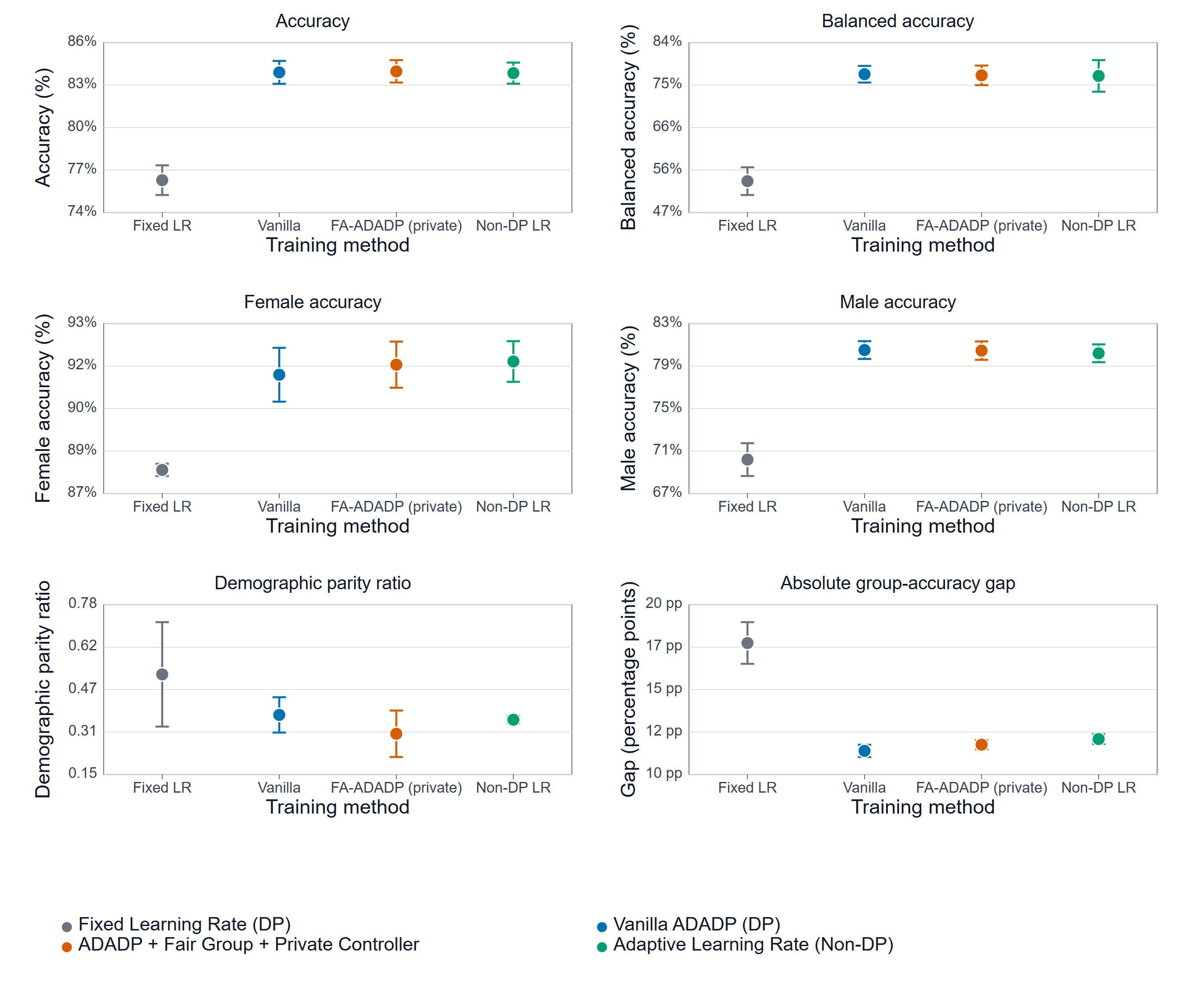
Research question
Differential privacy limits what a model can reveal about any one training record, but the clipping and noise that provide that protection can also redistribute errors unevenly. My thesis asks a narrower engineering question: can an adaptive optimizer respond when an underrepresented group is learning more slowly, while keeping the control path inside the privacy accounting?
What I built
I developed and evaluated DP-SGD training pipelines, reproduced fixed-learning-rate and ADADP baselines, and built a fairness-aware extension to ADADP. The controller compares relative group-loss progress and conservatively restrains learning-rate growth when the monitored group lags.
The first controller used raw group losses and was useful as a mechanism prototype, but it was not end-to-end private. The final version clips the signal, releases it with Gaussian noise on a schedule, and composes that cost with the training privacy budget.
Experimental design
- Skewed MNIST tests a deliberately underrepresented digit.
- Adult tests a protected demographic attribute under natural and skewed group ratios.
- Five paired seeds keep method comparisons aligned.
- The analysis reports overall and balanced accuracy, group accuracy, group gap, demographic parity ratio, and privacy expenditure.
- Private methods are compared at the same total privacy budget.
Results
On skewed MNIST, the underrepresented digit-8 accuracy was 48.12% with DP FixedLR, 60.40% with vanilla ADADP, and 65.30% with the final privacy-accounted fairness-aware controller. The group gap fell from 45.71 to 33.03 to 29.25 percentage points, respectively, at the same total ε = 2.
On Adult, the controller improved predictive utility but did not improve demographic parity ratio. That distinction matters: better group accuracy is not the same thing as equal positive prediction rates.
What the result means
This is a fairness-aware optimization heuristic, not a fairness guarantee. It shows that private optimization can react to group learning dynamics without silently spending extra privacy budget; it does not establish one universally best definition of fairness.